Thursday - April 07, 2005
 Egypt: Cairo
On April 4, the Queen Elizabeth 2 had the honor of being the very first tourist ship to dock at the new port of Ain Sokhna. We were also the first tourists to use the highway that the military built from Ain Sokhna to Cairo. The port went all out to welcome us. We were met by a band and male dancers dressed in multi-colored overskirts that they would take off and swirl over their heads as they twirled around like whirling dervishes. (And we were entertained with a wonderful display of fireworks as the tugs pulled us away in the evening.) There was a real sense of excitement in the air as we boarded our busses for the two-hour trip into Cairo. We were going to see the pyramids of Egypt! And not even the facts that we had to travel in a convoy escorted by cars of armed guards and that our muscles were still aching from Petra could dampen our enthusiasm.
From the three excursions on offer, Mike and I decided to do the tour that would take us to the Step Pyramids of King Zoser at Sakkara which predate those that we would see at Giza by many centuries. By seeing this site first we could see quite clearly how the pyramids had developed from rectangular and flat-topped mounds called mastabas. The great architect Imhotep came up with the idea of putting several mastabas one on top of the other for King Djoser's tomb. The result is aptly named, for the pyramid really does climb upward like a gigantic set of steps.
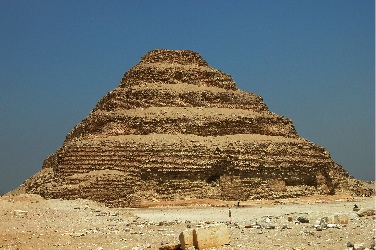
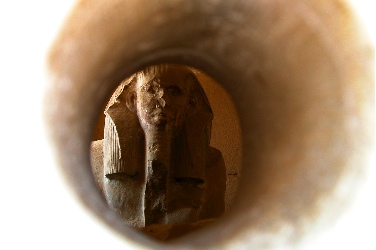
From a rise just beyond this pyramid, one can in the distance the first attempt at building a slope-sided pyramid, which we call the Bent Pyramid. The gradient is not steep enough so it looks as though the architect was merrily adding more and more stones and then thought, "Oops, this thing is supposed to come to a point..." and then started taking stones away from the top to make it more pointed. As interesting as these tombs themselves, was the drive through the delta countryside to reach the site. It is a very fertile area, with crops growing on both sides of the road and water buffaloes wandering through the fields. The houses are very colorful, painted all kinds of bright colors, and the streets are filled with children riding donkeys laden with feed for the cattle, men sitting in storefronts smoking hookah pipes, and women dressed in their black robes hanging out washing. There was an interesting picture everywhere I looked, People were very friendly and waved at us as we passed by, even though we were probably a big nuisance because traffic would be stopped and roads blocked to let us pass by.
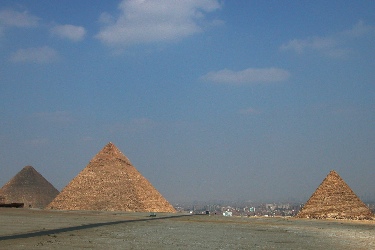
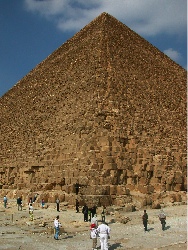
After lunch at the famous Mena Hotel, where one can see the Great Pyramid of Cheops through the window of the lounge, and the obligatory stop at the souvenir shop (where half the bus bought engraved gold cartouches), we arrived at the 4,500 year old Giza Pyramids, the last survivor of the Seven Wonders of the Ancient World. There are three major pyramids, side by side, on the edge of the desert. In the near distance, one can see the suburbs of Cairo, so it is a strange conjunction of the old and the new. The largest of the three, the Great Pyramid of Cheops, contains 2,300,000 blocks, each weighing more than two and a half tons. This, and the other two large pyramids, are an incfredible feat of engineering. With nothing to give them scale, they seem small until you stand below them, and then they seem staggering! The Cheops pyramid is 450 feet high. It is also aligned almost perfectly with the compass points. In fact it is more perfectly aligned that people realized until recently. The four faces are a few minutes off of true north, south, east, and west bearings, but there was a paper published a few years back which showed that the errors were almost entirely due to continental drift since it was built. When it was new it was aligned so closely that it would be hard to measure the error even now.
Unfortunately, unlike Petra, one is constantly accosted by Egyptian hawkers selling all manner of schlock and once they know where you are from, they all seem to have lived in Dallas or Chicago at some point in their lives. We were getting pretty tired of being hassled, and then we came across a fellow selling postcards. As he stepped into our path, we were about to tell him to get lost when he flipped out his accordion of postcards and called, "One dollar for the whole bluddy lot!" in a perfect Cockney accent. We were laughing so hard that he just walked away. It reminded us of a story that our destination lecturer had told when he was speaking about Egypt. He was getting annoyed at camel riders who were constantly getting in the way of his photographs and then asking for money for doing so. He had been told to say "Imshee" which when said calmly means "Leave me alone". When said more sternly, it means "Go away". When said in a very harsh tone, it means "Take off!" When one fellow wouldn't move out of his way after many requests, Peter used the harsh version. To his amazement, the camel jockey looked down at him disdainfully, and in a perfect Oxford accent said "F**k off to you too!"
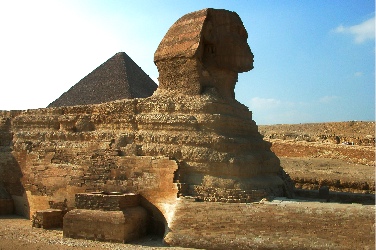
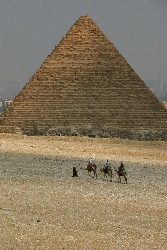
Our last stop before heading back to the ship was a short ride down the hill from the pyramids to see the Sphinx. Carved from natural limestone, this magnificent statue stands 66 feet high. The face has been badly eroded by time and battered by the Turks who used it for target practice, but one can still feel the majesty of the beast. We were able to walk up to a ledge that parallels the length of the body, so we got a very good look at it. I have to admit though that as much as I was impressed by these amazing feats of engineering, they didn't have the emotional impact for me that Petra did. Maybe it was because I was seeing them second. Having said that though, I still want to come back to Egypt for a few weeks when we can said down the Nile to Luxor and Thebes and see more of Egypt's ancient wonders.