Wednesday - January 12, 2005
 Traversing the Panama Canal
Mike spent practically the whole day, from 7 am till about 6 pm, standing on the observation deck on the bow watching the entire process as the ship moved through the 3 sets of locks that took us from the Atlantic Ocean to the Pacific.
After a very hot and sunny day at sea, it was time for one of the most interesting parts of the trip - the voyage through the Panama Canal . We had listened to an excellent lecture by our World Cruise Destination Lecturer, Dr. Peter Crimes, which prepared us for what we would see today. And Dr. Crimes was on the bridge, talking us through every step of the process, which made it even more interesting.
It is rather boring to describe the process, because things happen slowly and most people know how sets of locks work, but it is the sheer size of this operation that makes it quite special, not to mention the size of the ships that pass through the canal. And unlike normal locks, these three sets are broken up by lakes, cuts, and canals that must be traversed. But I will give you a bit of factual information that I think will give you some idea of the scope of the operation.
- The Panama Canal was opened to commercial ship traffic in 1914 and since that time, approximately 850,000 ships carrying 9 billion tons of cargo have gone through the waterway.
- Each lock chamber holds 65,800,000 gallons of water. By the time we had made the complete transit, some 52 million gallons of fresh water had spilled into the sea.
- The lock gates (of which there are forty) at each end of the chambers are steel structures 65 feet wide and 7 feet thick. They vary in height from 47 to 82 feet and weigh from 390 to 730 tons.
- The maximum dimensions of ships that can go through the Canal are 965 feet in length and 106 feet in width. The QE2 makes it with about a foot and a half to spare on each side!
- The only time that the captain of this ship gives up control is when the QE2 goes through the Canal. It is mandatory that a pilot come on board and physically guide the ship through the Canal. If any damage is done to the ship, the Canal Authority takes financial responsibility for those damages. Other special canal pilots also come on board and they communicate continuously with a control center, as well as linesmen, the towing "mule" drivers, and the lock engineers. Handling the lines at the bow and the stern are linesmen of the Panama Canal who have to attach the ship to the towing mules (these are electric locomotives which use cables to align and tow the ships) at the locks. Working in pairs, the mules move on rails and keep the vessel in position within the lock chambers. We needed four locomotives to move our ship.
- It cost Cunard in excess of $250,000 US in toll fees to make the transit.
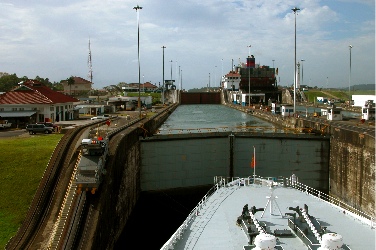
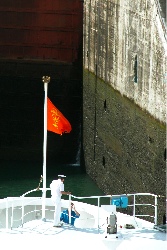
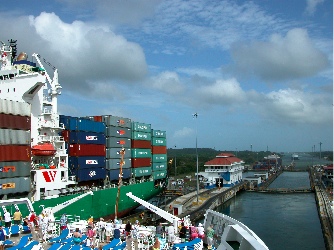
We were very lucky that it was somewhat overcast and the humidity was only at 72% today. It would have been brutal to stand out there all day otherwise. But it was great fun to watch the container ship from China that entered the lock beside us at about the same time we entered the first lock because we could see all that was happening from a bird's eye view. When we passed through the last set of locks at Miraflores, there were great crowds of people standing on three sets of balconies, waiting to see us come through. They were all clapping and cheering as an announcer on a PA system was describing the ship. I don't speak Spanish, but I am quite sure that the crowds weren't cheering for the Chinese container ship! Even after 40+ years in service, the QE2 still attracts great interest wherever she goes. And when she sounds her deep whistle, which Daniel, a fellow passenger, has named Tallulah Bankhead, it never fails to give me goose bumps, along with everyone else within hearing range.
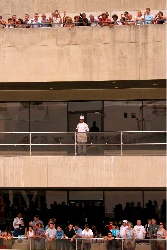
Mike, of course, was fascinated with the whole process and thought it was a great day, as did I. After we had sailed under the Bridge of the Americas and entered the Pacific Ocean, the crowds on deck dispersed. We found a couple of deck chairs on Sun deck, and sat and watched the sun set as we looked over to the skyscrapers of Panama City in the distance. It was very quiet, and we had to comment on how lucky we were to have experienced a day like this, on a ship such as this one.